

CBT Therapy Treatment in Atlanta helps you understand how your thoughts affect your emotions, actions, and daily choices. When anxiety, stress, trauma, or low mood takes over, you may feel stuck in the same painful loop. We help you slow that loop down, understand it, and build healthier ways to respond. At Perimetertx, we support adults who want clear tools, steady care, and real-life progress. You do not have to manage your mental health alone when the right support can guide your next step.
How CBT Therapy Treatment in Atlanta Helps You Break the Stress Cycle
CBT Therapy Treatment in Atlanta can help you understand the link between your thoughts, emotions, and behavior. In our clinical experience, many people feel anxious because their mind keeps repeating worst-case thoughts. You may know those thoughts feel too strong, yet your body still reacts as if danger is near. CBT gives you a clear way to pause, test the thought, and choose a healthier response.
We often see clients who feel tired from overthinking, panic, pressure, guilt, or fear of failure. CBT counseling helps you notice these patterns without shame. You learn how stress affects your sleep, focus, work, relationships, and recovery. Then we help you practice small daily skills that fit your real life. If anxiety has started to control your day, you can also learn more about our support for anxiety treatment in Atlanta
Common Pain Points CBT Counseling Can Help You Manage
CBT counseling works best when it connects with your real problems, not just textbook symptoms. You may feel stuck because you keep reacting the same way, even when you want change. In our experience, CBT helps when you need structure, practical steps, and honest support.
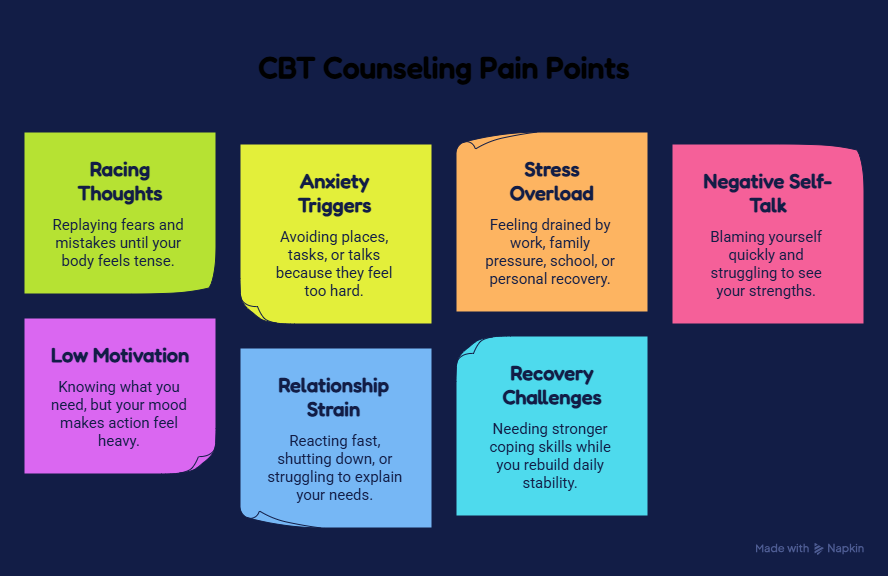
Common pain points may include:
- Racing Thoughts: You replay fears, mistakes, or future problems until your body feels tense.
- Anxiety Triggers: You avoid places, tasks, or talks because they feel too hard.
- Stress Overload: You feel drained by work, family pressure, school, or personal recovery.
- Negative Self-Talk: You blame yourself quickly and struggle to see your strengths.
- Low Motivation: You know what you need, but your mood makes action feel heavy.
- Relationship Strain: You react fast, shut down, or struggle to explain your needs.
- Recovery Challenges: You need stronger coping skills while you rebuild daily stability.
CBT does not erase every hard feeling overnight. It gives you tools you can practice. Over time, you learn how to respond with more control, clarity, and self-trust.
What Happens During Mental Health CBT Therapy?
Mental health CBT therapy usually starts with a clear conversation about your symptoms, goals, stressors, and daily patterns. We ask what feels hardest right now because your treatment should match your real life. You may work on anxiety, stress, depression, trauma responses, mood changes, or recovery skills.
A cognitive behavioral therapist helps you identify thoughts that increase emotional pain. Then you learn how to challenge those thoughts with facts, balance, and healthier action. You may also practice breathing tools, behavior changes, journaling, exposure skills, or problem-solving steps between sessions. CBT works well when you stay active in the process. Your therapist guides you, but you also practice skills outside the room. That practice helps your brain build new habits.
| CBT Focus Area | What You Work On | How It Can Help |
| Thoughts | Fear, worry, self-criticism | You learn to test thoughts more clearly |
| Emotions | Anxiety, sadness, anger, shame | You learn safer ways to respond |
| Actions | Avoidance, shutdown, overreaction | You build healthier behavior patterns |
| Coping Skills | Breathing, planning, communication | You gain tools for daily stress |
| Recovery Support | Triggers, relapse risks, routines | You create stronger emotional stability |
If depression affects your energy or hope, our depression treatment page may also help
Benefits of CBT Therapy for Anxiety, Stress, and Recovery
The benefits of CBT therapy often start with awareness. You begin to notice what your mind says before your body reacts. That moment matters because it gives you space to choose a better response. We have seen clients feel more hopeful when they realize their thoughts can change.
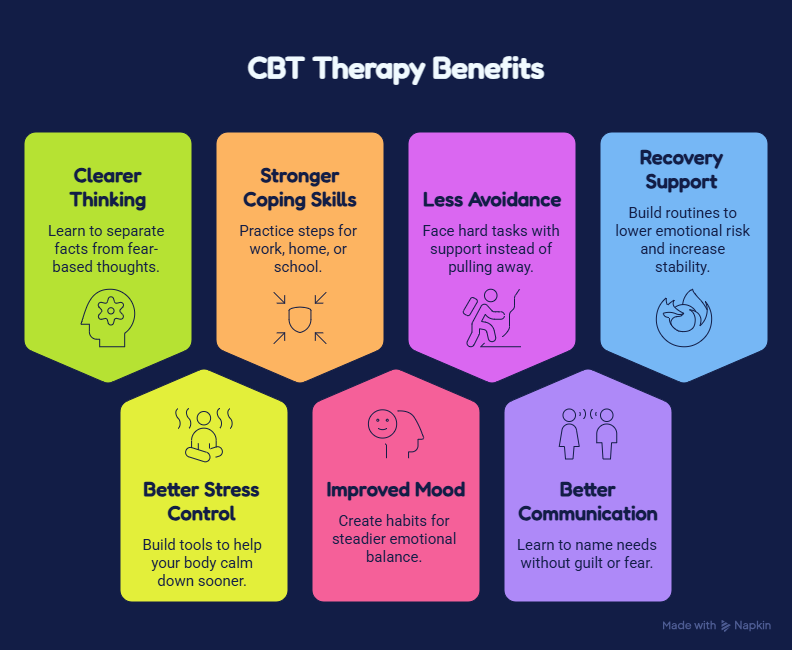
Helpful benefits may include:
- Clearer Thinking: You learn how to separate facts from fear-based thoughts.
- Better Stress Control: You build tools that help your body calm down sooner.
- Stronger Coping Skills: You practice steps you can use at work, home, or school.
- Improved Mood: You create habits that support steadier emotional balance.
- Less Avoidance: You face hard tasks with support instead of pulling away.
- Better Communication: You learn how to name needs without guilt or fear.
- Recovery Support: You build routines that lower emotional risk and increase stability.
CBT therapy is not about forcing positive thoughts. It is about building fair, useful, and realistic thoughts. When you practice these skills with a trained CBT therapist, your daily life can start to feel more manageable. For a higher level of structured support, you can review our Intensive Outpatient Program here
Why Work With a Cognitive Behavioral Therapist in Atlanta?
A cognitive behavioral therapist helps you move from confusion to structure. When anxiety or stress feels loud, it can be hard to know where to start. We help you name the pattern first. Then we guide you toward small steps that make sense for your goals, schedule, and symptoms.
Local support also matters. Atlanta can feel fast, busy, and demanding, especially when you manage work, family, school, or recovery. At Perimetertx, we understand that care must feel practical, respectful, and easy to follow. We do not expect you to have perfect words or perfect progress. We meet you where you are and help you build from there. If you need more support than weekly therapy, our Partial Hospitalization Program may fit your needs
FAQs About CBT Therapy Treatment in Atlanta
1. What is CBT Therapy Treatment in Atlanta?
CBT Therapy Treatment in Atlanta helps you understand how your thoughts, feelings, and actions connect. A therapist helps you spot unhelpful patterns and replace them with healthier coping skills. Many people use CBT for anxiety, stress, depression, trauma symptoms, and recovery support.
2. How long does CBT counseling take to work?
The timeline depends on your symptoms, goals, and level of care. Some people notice small changes within a few sessions because CBT gives practical tools. Deeper patterns may take longer, especially when anxiety, trauma, or depression has affected you for years.
3. Is CBT therapy good for anxiety and stress?
Yes, CBT therapy often helps anxiety and stress because it teaches you how to respond to fear-based thoughts. You learn how to reduce avoidance, calm your body, and take healthier action. It works best when you practice the skills between sessions.
4. What is the difference between CBT and regular talk therapy?
CBT is usually more structured than open-ended talk therapy. You still talk about feelings and life stress, but you also work on thought patterns, behavior changes, and coping tools. Many clients like CBT because it gives them clear steps to practice.
5. Can CBT help with recovery and emotional triggers?
CBT can support recovery by helping you understand triggers, cravings, shame, and high-risk thoughts. You learn how to respond before emotions push you into old habits. At Perimetertx, we may combine CBT with program support when you need more structure.
Start CBT Therapy Treatment in Atlanta With Perimetertx
If anxiety, stress, depression, or recovery challenges keep affecting your life, we can help you take the next step. CBT Therapy Treatment in Atlanta gives you practical tools, steady guidance, and a clear path toward healthier thinking. We listen first, then we help you build skills that fit your daily life.
Contact Perimetertx today to ask about care options, program levels, and mental health CBT therapy in Atlanta. If you feel unsafe or in immediate crisis, call or text 988 now. For non-emergency treatment support, reach out to our team.
Phone: 404-383-7826
Email: help@perimeterdetox.com